|
|
|
| Project
NEEED
villages:
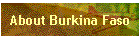
Until recent years, a village school in Burkina Faso, if there was one, was usually under a "hangar," a straw roof on timber supports. Now many village schools are in buildings constructed as part of outside development efforts, but they are often unstaffed because of a lack of teacher housing and because of severe teacher shortages. Consequently, many children who could go to school do not. Furthermore, families are often reluctant to send girls to school, since girls are needed to work at home and since women leave the family compound with their husbands when they marry (families do not see a return on their investment). Many teachers and students from Ouahigouya have ties to the rural villages in the Yatenga region outside of town, especially in the area around the village of Tangay, This region is in the north central part of Burkina Faso, shown in blue/violet on the detailed map. One small group of professionals in the Ouahigouya area has formed an association called NEEED (Nimbus-Enfance-Education-Environnement-Développement). NEEED's primary activity is a project to encourage families in villages to send their young girls to primary school. In Burkina Faso, as in much of West Africa, girls and women are considerably less represented than their male counterparts at all levels of the educational system. The basic idea of the project is to support the girls through their first year of school with school supplies, textbooks, and school fees. Hand in hand with this financial support is the purchase of a lamb for the girl to raise with the help of her mother or family. If all goes well, the girl and her family will sell the sheep a year later and get enough money to buy another lamb and also support her ongoing education costs. A critical component of the program is working with the community and families on the importance of their support for their children's education and the ongoing involvement of local professionals with the community. Thus far, UNICEF has supplied some of the school supplies for the first two years of the program, with the bulk of school costs and lambs left to limited donations from the association with its partners in Germany and the United States. Currently, it costs about $10 a year to send a pupil to primary school and about $25 to purchase a lamb, and the project has been necessarily limited in scope. If adequate funding is obtained, future plans include extending support to a few other villages in the area, who have already heard about the project. Additionally, partners have suggested extending support to boys as well as girls, with the stipulation that at least half the participants would be girls. This can help build a stronger base of support (and less conflict) within the communities and participating families, while still addressing both the critical need for education in general and the special need to educate girls. The NEEED project is based in part on a breeding model used in other developing nations. As implemented in the Yatenga region, it can serve as a model for other Burkinabè communities. If you are interested in supporting NEEED's activities, you can e-mail Laciné SAWADOGO in French, or to support NEEED or other small development projects in Burkina Faso, e-mail Friends of Burkina Faso in English.
Click on a thumbnail to see the larger photo.
| ||||||||||||||||||||
|